
Arbitration vs Litigation in Complex Property Settlements: What’s the Difference?

When you are dealing with a complex property settlement, there can be more at stake than simply deciding who keeps the house. You may be dealing with businesses, trusts, investments, multiple properties, significant superannuation or other financial interests.
When negotiations become difficult, you may hear terms like arbitration and litigation. But what do they actually mean, and how do you know which pathway is right for your situation?
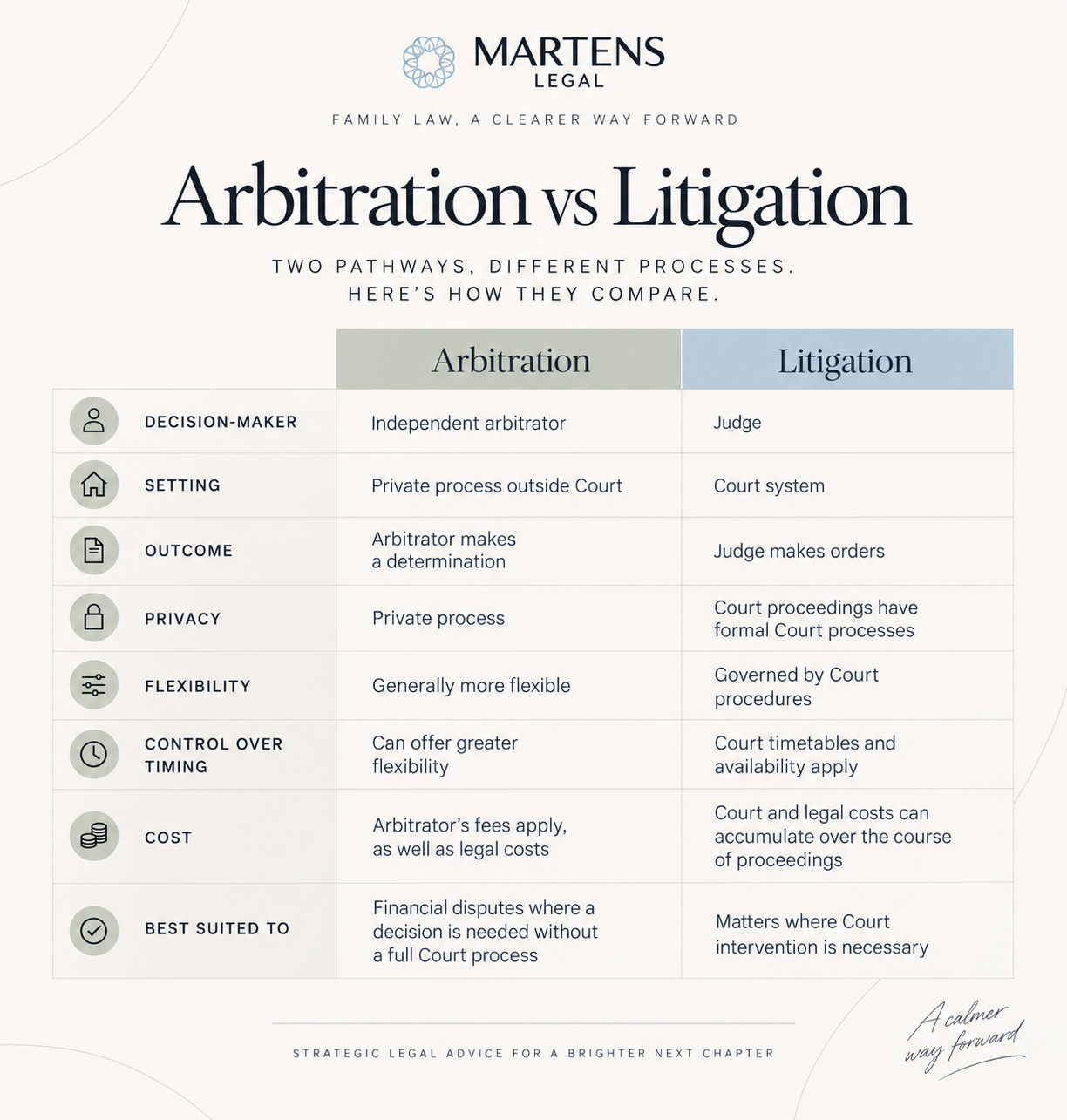
The key difference is who makes the decision. In arbitration, you and your former partner present your financial dispute to an independent arbitrator, who makes a determination. In litigation, the dispute is determined by a judge through the Court process.
For people who want a clear outcome but would prefer to avoid the time, formality and public nature of Court proceedings, arbitration can be an important alternative.
What is family law arbitration?
Family law arbitration is a process used to resolve certain financial and property disputes outside the judicial process.
Rather than having a judge determine the dispute, the parties present their arguments and evidence to an independent arbitrator. The arbitrator then makes a determination about the dispute. This is different from mediation, where the mediator helps the parties negotiate but does not make the decision for them.
Arbitration can be particularly relevant where the parties have been unable to reach agreement but still want to avoid going through a full Court process.
It can be useful in complex matters involving issues such as:
Property and real estate
Businesses and business interests
Investments
Superannuation
Trust interests
Significant financial assets and liabilities
The Family Law Act 1975 provides for arbitration of certain property and financial disputes, and also provides mechanisms for arbitration awards to be registered with the Court.
For someone with a complicated asset pool, arbitration can provide another pathway between negotiation and full litigation.
Related article: How Are Assets Divided in a Divorce?
What is litigation in a property settlement?
Litigation means taking your dispute through the Court system.
If you and your former partner cannot reach an agreement, a judge can ultimately determine the outcome of your property settlement. The Court process is formal and involves specific procedures, evidence, deadlines and hearings.
Litigation may be appropriate where:
Negotiation has failed
Mediation has been unsuccessful
The other party is refusing to cooperate
There are urgent issues requiring Court intervention
There are significant disputes about disclosure or assets
There are complex legal issues that require judicial determination
There are safety or power imbalance concerns
Litigation is not necessarily a sign that you have done something wrong or that your separation has become a "war". Sometimes Court intervention is genuinely necessary.
However, where a matter can be resolved outside Court, there can be significant advantages to exploring those options first. Martens Legal's approach is resolution-focused, with litigation available when negotiation, mediation or arbitration is not appropriate or successful.
Arbitration vs litigation: what are the key differences?
At a glance, the biggest difference is where the decision is made and who makes it.
The Family Law Act specifically recognises that an arbitrator may charge fees for conducting an arbitration and requires information about those fees to be provided before the arbitration starts.
This means arbitration is not necessarily "cheap". The advantage is that, depending on the circumstances, it may provide a more streamlined pathway to a decision than traditional litigation.
👉 Arbitration support for property and financial matters after separation in Brisbane.
When might arbitration be better than litigation?
Arbitration can be particularly attractive when you have reached the point where you need a decision, but you do not necessarily need a courtroom.
For example, imagine you and your former partner have been separated for some time. You agree on most aspects of your property settlement, but there is a significant disagreement about the value of a business or another complex financial asset.
You have tried negotiating. You may even have attended mediation. But you cannot agree.
Instead of immediately moving into a lengthy Court process, arbitration may provide a pathway for the remaining dispute to be determined.
This can be particularly appealing for people who value:
Privacy: You may prefer to resolve a highly personal financial dispute outside the traditional Court process.
Efficiency: If the dispute can be narrowed to specific financial issues, arbitration may provide a more streamlined process.
A decision: Unlike mediation, you are not relying on both parties to reach an agreement. The arbitrator makes a determination.
Resolution without unnecessary conflict: If your goal is to resolve your property dispute rather than prolong the conflict, arbitration can fit within a resolution-focused strategy.
This is particularly relevant to people with complex financial circumstances who want their matter resolved properly and discreetly. Martens Legal's client strategy identifies arbitration as an important option for higher-value, complex property matters where clients want a private, binding resolution without Court.
How does the arbitration process work?
While every matter is different, the process will generally involve several key stages.
1. Assess whether arbitration is appropriate
The first step is understanding the dispute, the assets involved, what has already been attempted and whether arbitration is suitable.
You should also obtain legal advice before agreeing to an arbitration process.
2. Identify the issues in dispute
Your lawyer will help identify exactly what you and your former partner disagree about.
In a complex property settlement, this could involve the value of a business, treatment of superannuation, ownership of an asset, contributions or how the overall property pool should be divided.
3. Gather financial information and evidence
A decision-maker needs reliable information.
This may involve gathering documents relating to:
Property
Mortgages and other debts
Bank accounts
Superannuation
Businesses
Companies and trusts
Investments
Taxation
Other financial interests
4. Present your position
Your lawyer will help prepare and present your legal and financial position, including the evidence supporting it.
The other party will have an opportunity to present their position as well.
5. The arbitrator makes a determination
Unlike mediation, the arbitrator makes the decision.
The resulting award can then be dealt with through the mechanisms available under the Family Law Act, including registration with the Court where appropriate.
The important point is that arbitration is not simply another negotiation meeting. It is a decision-making process.
What can go wrong with arbitration or litigation?
Neither pathway should be chosen simply because it sounds faster or more formal.
The wrong strategy can cost you time, money and emotional energy.
Choosing litigation too early
Going straight to Court may not be necessary if there is still a realistic opportunity to resolve the dispute through negotiation, mediation or arbitration.
Court proceedings can become complex, particularly when the issues and asset pool are substantial.
Assuming arbitration is always cheaper
Arbitration involves professional fees, including the arbitrator's fees, as well as your own legal costs. The Family Law Act expressly provides for arbitrator fees.
The question is not simply "Which option costs less?"
It is "Which pathway is proportional to the dispute and most likely to get us to a sensible resolution?"
Going into arbitration without proper preparation
Complex property disputes require proper financial disclosure, evidence and legal strategy.
If important information is missing or the value of an asset is disputed, your lawyer needs to understand that before the arbitration begins.
Assuming the process is right for every matter
Arbitration is not automatically the best alternative to Court.
Your circumstances matter. The nature of the dispute, the behaviour of the other party, the complexity of the assets, urgency, safety concerns and your overall objectives should all be considered before choosing a pathway.
So, should you choose arbitration or litigation?
There is no universal answer.
For some separating couples, negotiation or mediation will be the most appropriate option. For others, arbitration can provide a private pathway to a decision when agreement has become difficult.
And in some cases, Court litigation is necessary.
The goal should not be to avoid Court at all costs. The goal should be to choose the right pathway for your circumstances.
If you have a complex property settlement involving a business, multiple properties, investments, superannuation or other significant financial interests, getting strategic legal advice early can help you understand your options before the dispute becomes more difficult.
At Martens Legal, we focus on resolving property matters with as little unnecessary conflict as possible. That might mean direct negotiation, lawyer-to-lawyer negotiation, mediation, arbitration or, where necessary, Court representation.
Whether you're navigating a separation, sorting out property, or making parenting arrangements, our services are designed to help you move forward with clarity, confidence, and a plan that’s tailored to you.
If you are unsure where your matter sits, you do not need to have the answer before you seek advice.
You just need to know that you want a clear way forward.
Frequently Asked Questions
Is arbitration the same as mediation?
No. In mediation, an independent mediator helps the parties negotiate towards an agreement but does not make the decision for them. In arbitration, the arbitrator considers the dispute and makes a determination.
Is arbitration legally binding?
Family law arbitration is designed to provide a determination of the financial dispute, with the Family Law Act providing mechanisms for arbitration awards to be registered with the Court. There are also statutory mechanisms relating to review and setting aside of registered awards.
The exact legal effect of an arbitration award will depend on the circumstances, so you should obtain legal advice before agreeing to arbitration.
Is arbitration cheaper than going to court?
It can be, but there is no guarantee. Arbitration involves the arbitrator's fees as well as your legal costs. Whether it is more cost-effective than litigation depends on the complexity of the dispute and how the process is conducted.
Can arbitration be used for a complex property settlement?
Yes. Arbitration is specifically available for certain financial and property disputes under the Family Law Act. It can be particularly relevant where the parties need a decision about complex financial issues but want to consider an alternative to a full Court process.
Do I need a lawyer for arbitration?
Given the legal and financial complexity that can arise in a property settlement, obtaining independent legal advice is strongly recommended. Your lawyer can help you understand whether arbitration is appropriate, prepare your case and protect your interests throughout the process.
What if arbitration does not seem appropriate for my situation?
There are other pathways available. Depending on your circumstances, your matter may be better suited to negotiation, mediation or Court litigation. The right approach depends on the issues in dispute, your former partner's willingness to participate and the complexity of your financial circumstances.
Related article: Mediation vs Court: Making Informed Choices
A final word
A complex property settlement does not automatically mean you need to go to court.
Sometimes, the smartest strategy is finding a way to get a clear, enforceable outcome without putting your entire separation through the litigation process.
Arbitration can be one of those options.
If you are dealing with a complicated property pool and are unsure whether negotiation, mediation, arbitration or litigation is the right next step, getting advice early can help you make the decision from a position of clarity rather than pressure.
Martens Legal helps clients across Brisbane, North Brisbane and beyond navigate complex property settlements with clear, strategic and resolution-focused legal advice.
Ready to take the next step?
Starting over after separation is hard. Knowing where to start shouldn’t be.
Our Separation Starter is a simple, personalised way to gain clarity about your situation and understand what your next steps may look like.
Complete the short questionnaire and our team will personally review your answers, providing guidance tailored to your circumstances.
Take the first step towards clarity, confidence and a plan forward.
👉 Complete the Separation Starter today.
Disclaimer: This article provides general information only and does not constitute legal advice. Every separation and property settlement is different. You should obtain legal advice about your individual circumstances before making decisions about your property or financial interests.