
What Does a Property Settlement Cost? Mediation vs Court

If you are going through a separation, one of the first questions you are likely to have is: how much will a property settlement cost?
The honest answer is that there is no single price tag. The cost depends on the complexity of your financial circumstances, whether you and your former partner can reach an agreement, how much negotiation is required and whether your matter ends up in court.
For many separating couples, the biggest difference in cost comes down to how the dispute is resolved. Negotiating a property settlement or attending mediation can provide a way forward without the time, stress and expense associated with court proceedings.
Martens Legal's approach is focused on resolving property matters without court wherever possible.
If you are worried that hiring a lawyer automatically means an enormous legal bill, you are not alone. Cost anxiety is one of the key barriers identified for people seeking legal help during separation. Clear information about your options can help you make decisions based on your circumstances rather than fear.
What makes a property settlement expensive?
There are several different costs that can arise during a property settlement.
The first is legal fees. You will likely need a lawyer to advise you about your entitlements, negotiate with your former partner or their lawyer, prepare legal documents and help you reach a legally binding outcome.
The amount of legal work required will depend on your circumstances.
A relatively straightforward matter where both people are prepared to negotiate can require significantly less work than a matter involving complex assets, disagreement about contributions or repeated negotiations.
Other factors that can affect the cost include:
The number and value of assets and liabilities involved
Whether you own property together
Whether there are businesses, investments or significant superannuation interests
Whether you and your former partner agree about the value of assets
How willing each person is to negotiate
How much correspondence and negotiation is required
Whether mediation is appropriate
Whether court proceedings become necessary
This is why an advertised hourly rate on its own does not tell you what your property settlement will actually cost.
The more useful question is: what approach is likely to resolve my particular situation efficiently and fairly?
Reaching an agreement is an important step, but it is equally important to make sure that agreement is properly documented and legally enforceable.
Read more about why clear separation agreements matter.
Is mediation cheaper than going to court?
In many cases, mediation can be a more cost-effective alternative to court proceedings.
Mediation is a dispute resolution process where you and your former partner work towards reaching an agreement with the assistance of a neutral mediator. You can have your lawyer involved to provide legal advice and help you understand the implications of any proposed agreement.
The key difference is that mediation is focused on reaching a resolution rather than asking a judge to determine the outcome.
Court proceedings can involve multiple steps over an extended period. This can mean additional legal work, preparation, correspondence, hearings and other expenses.
Mediation can reduce some of that work when both parties are genuinely prepared to negotiate.
It is important to understand, however, that mediation is not automatically appropriate or successful in every matter. The right approach depends on your circumstances, including the complexity of the property pool and the level of disagreement between you and your former partner.
For Martens Legal, mediation and negotiated property settlements are a central part of the firm's resolution-first approach. The firm's strategy specifically identifies mediation and arbitration as competitive differentiators, with court positioned as a last resort where resolution outside court is genuinely impossible.
What does a property settlement through mediation involve?
If mediation is appropriate for your situation, the process will generally involve several stages.
1. Understand the financial position
Before you can negotiate a fair settlement, you need to understand what you actually have.
This can include the family home, other real estate, bank accounts, investments, vehicles, businesses, superannuation and debts.
Your lawyer can help identify the relevant assets and liabilities and consider the financial information that needs to be exchanged.
2. Get legal advice
Before agreeing to dividing up your property or making an offer, it is important to understand how the law applies to your circumstances.
This is particularly important if you have been together for many years, have made different financial and non-financial contributions, or have a more complex asset pool.
3. Negotiate
Your lawyer may negotiate directly with your former partner or their lawyer before mediation.
Sometimes an agreement can be reached without mediation at all.
4. Attend mediation
If an agreement has not already been reached, mediation provides an opportunity to work through the outstanding issues with an independent mediator.
Your lawyer can help you understand your options throughout the process.
5. Formalise the agreement
Reaching an agreement is not necessarily the end of the process.
Depending on your circumstances, the agreement may need to be documented appropriately, such as through consent orders or another legally appropriate arrangement.
Your lawyer can advise you about the best way to formalise your settlement.
Property disputes are one of the most common issues separating couples need to resolve. This can include deciding what happens to the family home, regardless of whose name appears on the title.
If you're unsure how ownership of the family home is treated after separation, read Can I Keep the House If My Name Is on the Title?.
What about going to court?
Sometimes court is unavoidable.
If you and your former partner cannot reach an agreement despite genuine attempts to negotiate, court proceedings may become necessary.
The court gives a judge the power to determine the issues that the parties cannot resolve themselves. However, it is generally a more involved process than reaching an agreement through negotiation or mediation.
It can also be difficult to predict exactly how much work will be required because the matter develops as it progresses.
For someone already worried about the financial impact of separation, this uncertainty can be particularly stressful.
This is one reason the Martens Legal strategy specifically focuses on property resolution without court intervention wherever possible. The ideal clients identified in the strategy are often not looking for a fight. They want their financial position resolved fairly, with as little conflict and disruption as possible.
Mediation vs court at a glance
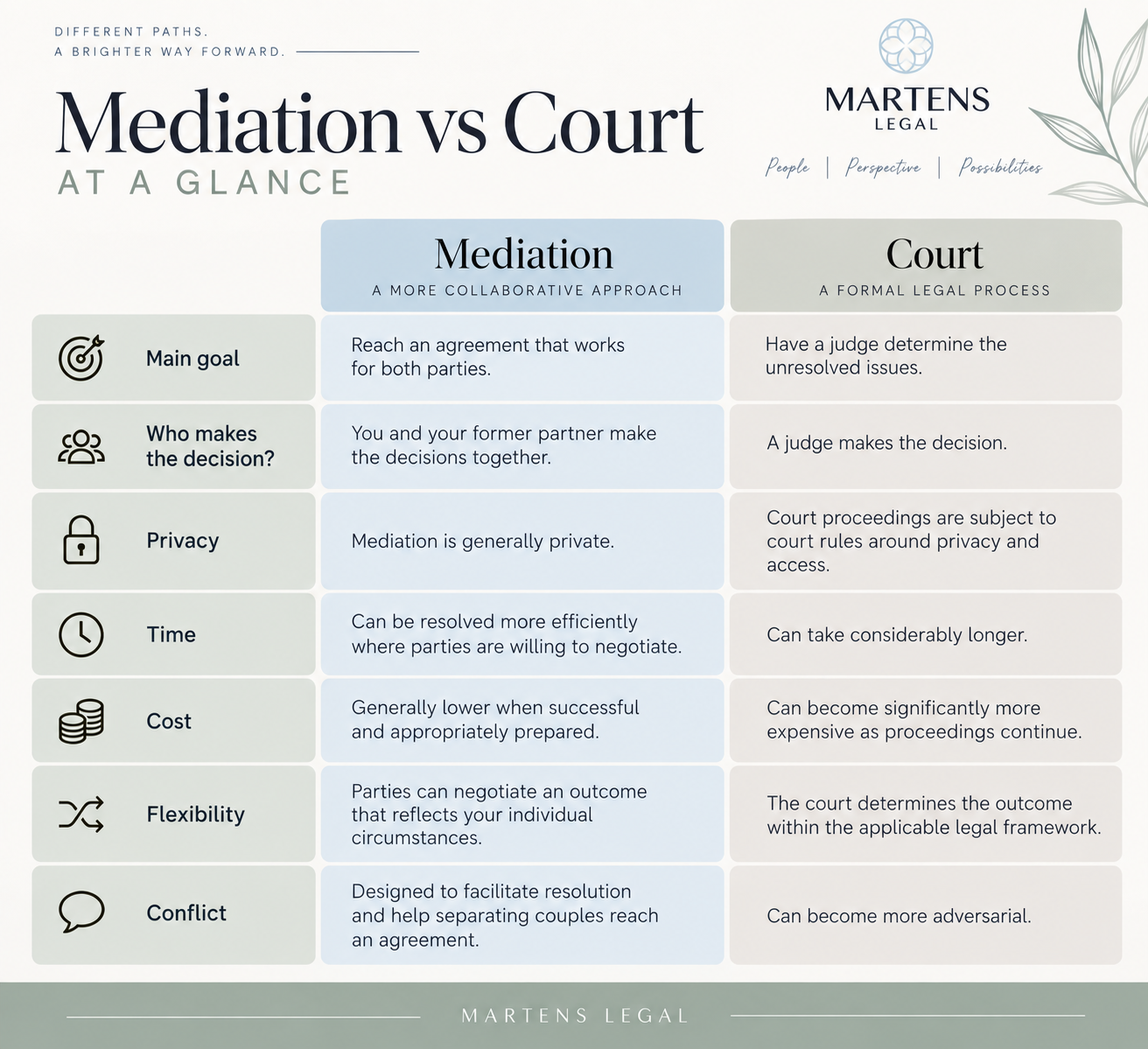
Mediation can be an effective alternative to court proceedings. The Federal Circuit and Family Court of Australia explains that dispute resolution can provide a more affordable and timely way of resolving disputes while giving parties greater input into the process and outcome.
Read more about mediation through the Federal Circuit and Family Court of Australia.
Considering mediation? If you and your former partner are open to reaching an agreement but you want legal support throughout the process, our Mediation with Legal Support service can help you prepare, understand your position and work towards a resolution without rushing to Court.
Learn more about Mediation with Legal Support
What can go wrong if you focus only on the cheapest option?
Trying to save money by avoiding legal advice altogether can sometimes create a much bigger problem.
A property settlement is not simply about deciding who gets the house or agreeing to a percentage split.
There may be superannuation, debts, investments, businesses and other financial interests to consider. The value of assets can also change, and the way an agreement is documented matters.
A settlement that looks inexpensive at the beginning may become expensive later if it has not properly addressed the financial relationship.
There is also a difference between cheap legal help and efficient legal help.
The cheapest option is not necessarily the one that gets you the best outcome or gives you confidence that your financial affairs have actually been resolved.
The goal should be to find a resolution that is fair, legally sound and proportionate to the circumstances.
That is particularly important if you have spent many years building your financial position with your former partner. The research identifies concerns about an unfair division of assets, losing the family home and legal costs eating into the property pool as some of the key fears people experience during separation.
How can you keep property settlement costs under control?
While you cannot always predict exactly what your matter will cost, there are practical things you can do to avoid unnecessary legal expenses.
Get advice early
Understanding your position before making major decisions can help you avoid costly mistakes.
Get organised
Gather information about your assets, liabilities, income and financial accounts. The more complete the information available to your lawyer, the easier it can be to assess your situation.
Keep communication focused
If negotiations are underway, keeping communication practical and focused on resolving the financial issues can help avoid unnecessary conflict.
Consider negotiation or mediation
If an agreement is realistically achievable, resolving your matter outside court may save significant time and legal expense.
Understand the likely costs before proceeding
Ask your lawyer how they charge, what work is likely to be required and what factors could increase the cost.
Most importantly, don't choose a legal strategy based on cost alone. Choose the strategy that makes sense for your circumstances and your desired outcome.
Frequently asked questions about property settlement costs
How much does a property settlement cost in Australia?
There is no standard cost for a property settlement. Legal fees depend on factors including the complexity of the asset pool, the level of disagreement and whether the matter can be resolved through negotiation or mediation.
Is mediation cheaper than court for property settlement?
Mediation can be significantly more cost-effective than court proceedings when it is suitable for the circumstances and results in an agreement. Court proceedings generally involve more stages and legal work, which can increase costs.
Do I need a lawyer for mediation?
You do not necessarily have to have a lawyer attend mediation with you, but obtaining legal advice can help you understand your position and the implications of any agreement before you make decisions.
Can property settlement be done without going to court?
Yes. Property matters can often be resolved through negotiation, mediation or other dispute resolution processes. The appropriate option depends on the circumstances of the matter.
What if my ex refuses to agree to a property settlement?
There are options if you cannot reach an agreement. Negotiation, mediation and, where appropriate, arbitration may help resolve the dispute. If resolution is genuinely not possible, court proceedings may ultimately be required.
Is it worth paying for a lawyer for a property settlement?
For many people, obtaining legal advice is worthwhile because a property settlement can have significant long-term financial consequences. A lawyer can help you understand your position, negotiate effectively and ensure your agreement is properly documented.
You don't have to start with court
If you're worried about the cost of your property settlement, the first step does not have to be launching into a court battle.
The better starting point is understanding what you're dealing with, what your options are and which approach is most likely to resolve your matter efficiently.
For some couples, that may mean direct negotiation. For others, mediation may provide the structure needed to reach an agreement. More complex financial matters may require a different approach.
And where court genuinely cannot be avoided, having the right legal strategy from the beginning can help you understand what you're facing.
At Martens Legal, the focus is on helping separating couples resolve property matters with clarity, confidence and as little unnecessary conflict as possible.
Your next step can be simpler than you think
Starting over after separation is hard. Knowing where to start shouldn’t be.
If you’re unsure what to do next, our Separation Starter is a simple place to begin.
Disclaimer
This article provides general information only and does not constitute legal advice. Every separation and property settlement is different. The information that applies to your circumstances will depend on your individual financial and personal situation. You should obtain legal advice before making decisions about your property settlement.